
Golf Body Assessment: Why Your Swing Keeps Breaking Down

Why do I need a Golf body assessment?
You've had lessons. Probably good ones.
You understood the move. You hit a few clean ones. You left the bay feeling like something had clicked.
Then two rounds later — same miss. Same tightness. Same feeling creeping in by the back nine.
At some point, most golfers just accept that as part of the game. Something to manage. A body that's not quite cooperating.
But if you actually stop and think about it, it doesn't add up. Because the golfers I work with aren't beginners. They train. They play regularly. They've invested in lessons. They're putting the effort in. And the same problems keep showing up.
That's not a bad technique. That's a body that hasn't been looked at properly.
The Industry's Dirty Secret
Golf instruction is a multi-billion-pound industry built almost entirely on one assumption — that swing faults are technique problems.
They're not. They're body problems wearing a technique disguise.
Research shows that over 60% of amateur golfers experience lower back pain during or after play, and the golf swing places up to eight times your bodyweight through the lumbar spine with every shot. That's a serious load — especially if your body isn't moving well underneath it.
When your hips aren't clearing, that's not a coaching issue. That's your hip mobility stopping where it should be starting. When your shoulder turn is short, that's not a mental block. That's a thoracic spine that's been slowly fusing from years of desk work. When your follow-through collapses, your body isn't being lazy — it's protecting a joint it doesn't trust to go any further.
Your coach watches your swing and tells you what to change. But if your body physically cannot do what they're asking, you will leave that lesson, try your hardest on the range, and be back in their bay within six weeks with the exact same fault.
Because the fault was never in your swing. It was in your body. And nobody looked there.
You're Not Just Getting Older
The most common thing I hear: "I think it's just age."
It isn't.
Stiffness, restricted rotation, back pain by the 12th hole, needing two days to recover from a weekend round — none of this is inevitable. It's the result of years of sitting, moving badly, and doing nothing specifically designed to counteract it.
Your body adapts to what you do most. If you sit for nine hours a day and play golf at the weekend, your body will be excellent at sitting and terrible at rotating. That's not ageing. That's adaptation. And adaptation can be reversed.
Here's what nobody in mainstream health will tell you: the standard threshold for "healthy" is shockingly low. Your bloods are fine. Your blood pressure is fine. Walk a bit more. Take these for the pain.
But "fine" and "able to generate a full rotational golf swing without compensation or pain" are not the same conversation. Masking pain to get through a round is not a strategy. It's a delay. The restriction is still there. The compensation is still building. And the body keeps finding new ways to work around what it can't do — until it can't anymore.
You can't medicate your way to a better backswing.

"But I've Tried Stretching"
Most golfers have tried stretching. Most quietly give up on it. Because it doesn't seem to transfer into their swing.
That's because passive stretching — the lie-on-the-floor, hold-for-30-seconds kind — isn't what the golf swing needs. Research consistently shows that mobility alone isn't enough. It has to be controlled and usable under movement. A golf swing is dynamic, loaded, and rotational. Static flexibility doesn't prepare a body for that.
And this is where the yoga myth does real damage.
The idea that yoga is just stretching is the most successful piece of misdirection in the wellness industry. If lying on a mat and holding positions fixed restricted golfers, you'd have fixed yourself already — at the end of every golf lesson, every physio session, every morning routine you've ever tried.
You haven't. Because that's not how bodies work.
One client, Alasdair, had been told for years that yoga would help his mobility. But it never clicked until he understood what his body actually needed. His words: "Kay's course was an eye opener — it has helped my golf swing, I am more flexible and increased my distance. My golf pro has noticed an improvement."
That shift didn't come from stretching harder. It came from a training movement his body could actually use.
What a Real Golf Body Assessment Looks Like
Before I work with any golfer, I run a full movement screen. Not a swing analysis — a body assessment.
One of the biggest physical limitations in golfers is a lack of hip internal rotation. Without it, you physically cannot load properly in your backswing or transition cleanly through the ball. So you try to rotate more — and your body compensates instead. You shift early, spin out, and your lower back starts absorbing load it was never designed to take.
Here's what I look at:
How your hips rotate — and whether they have the internal range to support a proper backswing load. Whether your thoracic spine can rotate independently of your hips, or whether your whole torso moves as one block. Whether there's asymmetry between your left and right side quietly destroying your consistency. Where your body is routing around a restriction — and what that's costing you in distance, accuracy, and energy every single round.
This takes about twenty minutes. It tells me more about why your swing is breaking down than hours of slow-motion video ever could.
Because here's what changes when you know the answer: everything makes sense. The early extension, the over-the-top move, the loss of posture mid-swing — these aren't bad habits. They're solutions. Your body found a workaround for something it couldn't do, and it's been using it ever since. Remove the restriction, and the compensations often disappear without you changing a single swing thought.
What Happens When You Fix the Body, Not the Swing
Nicholas came to me with knee pain that made crouching to read putts difficult. He wasn't convinced this would work. Two weeks later: "My knee pain is completely gone, my posture has improved, and my golf swing is starting to feel stronger and more stable."

Not from changing his swing. From changing what his body could do.
Martin was already playing at a good level — a solid four handicap, fit, and trained regularly. After working through his movement restrictions, specifically hip mobility and thoracic rotation, he played 36 holes in a single day. No aches. No pain. No spending the next two days on the sofa. He's now playing off two. His words: "My handicap dropped as a direct result of better flexibility and more energy — I managed 36 holes in one day without any aches or pains."
That's not just performance. That's capacity. That's what your body is supposed to feel like.
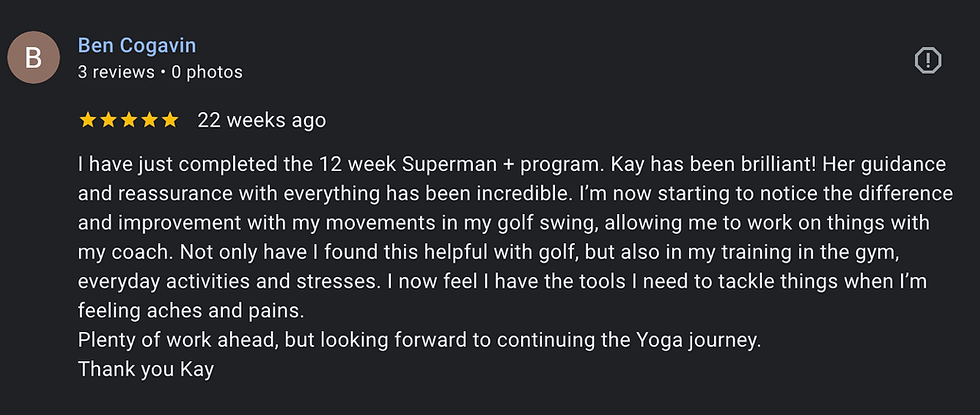
Ben noticed something slightly different — the bit most golfers don't expect: "I'm now starting to notice the difference in my movements in my golf swing — I feel I have the tools I need to tackle things when I'm feeling aches and pains."
That's when it becomes sustainable. Not just better golf now, but golf on your own terms for the next twenty years.
The Real Question
Most golfers don't suddenly stop. It's gradual.
You lose a bit of rotation. You adjust your swing slightly to compensate. You accept a bit more stiffness. Recovery takes longer. Rounds take more out of you. At some point you're not playing freely anymore — you're managing your body around the golf course instead of playing it.
So the real question isn't whether your swing needs work. It's whether your body is capable of the swing you're trying to make. And if it isn't, no amount of lessons, range time, or new equipment is going to change that.

What Happens on the Assessment
This isn't a swing lesson. It's a paid session where we look at how your body is actually moving — and how that's affecting your golf.
In around 20 minutes, we'll go through a few targeted movement checks to see where your rotation is limited and where your body is compensating. Most often, it's the hips not doing their job, so the lower back steps in and takes the hit. That's usually where the stiffness, the inconsistency, and the drop-off after 12 holes are coming from.
I'll explain what's going on in plain terms — no jargon, no vague advice — so you actually understand why what you've been trying hasn't worked. Then, before we finish, I'll give you one or two movements to try straight away so you can feel the difference for yourself.
You leave with a clear picture of what's limiting you and exactly what to focus on next.
Golf body assessment FAQ
Why does my golf swing keep breaking down even after lessons?
Almost always a physical restriction — hip mobility, thoracic rotation, or asymmetry — that swing coaching can't fix because it's a body issue, not a technique issue.
What does a golf body assessment involve?
A movement screen covering thoracic rotation, hip internal rotation, pelvic control, and lateral asymmetry. About twenty minutes. Shows you exactly where your body is limiting your swing.
Is golf back pain just part of getting older?
No. It's the result of restricted movement patterns and years of compensation. It's a signal — not a sentence.
How is this different from a regular golf lesson?
A golf lesson looks at your swing. This looks at your body. Most swing faults have a physical root cause that a swing coach isn't trained or equipped to find.
How quickly can this actually improve my golf?
Clients typically notice changes within two to four weeks. Martin dropped two shots and played 36 holes pain-free. Nicholas's knee pain was gone in two weeks. Results vary but the pattern is consistent.
Is lower back pain always a trapped nerve or sciatica?
No. That’s one of the most common misconceptions. What feels like sciatic pain isn’t always coming from a nerve issue — it’s often the result of how your body is moving and loading through the hips and lower back. When certain areas aren’t doing their job, others step in and take over, creating tension that can feel like nerve pain. Treating it as “just sciatica” often misses what’s actually driving it.
About Kay
Kay Wettasinghe is a Yoga Therapist, Golf Mobility Coach and Corporate Wellbeing Specialist with over 15,000 teaching hours. She helps golfers improve rotation, reduce back pain after golf and move more efficiently through short, strength-based mobility programmes.
📍 Essex & London | Online Coaching Worldwide
📅 Book a Golf Mobility Assessment:
Or explore more articles and videos:
🏌️ Website: www.yogabykay.com
📸 Instagram: @yogabykaylondon
▶️ YouTube: Yoga by Kay
📘 Facebook: Yoga by Kay


Comments